
Mirror Packing Checklist: Materials, Safe Wrapping Order, and Loading Rules

Mirrors are one of the easiest items to crack during a move—because the danger isn’t only a direct hit. Vibration in the truck, pressure on corners, loose hardware on the back, and even a slightly oversized box can turn “fine” into “spiderweb.” The good news: when you pack a mirror the same way pros pack framed art and glass panels, it travels safely—even across cities.
This 2026 guide covers everything from small vanity mirrors to full-length wall mirrors: the materials you actually need, the safest wrapping order, how to use a mirror box correctly, and how to load mirrors in the truck so they don’t flex or get crushed.
Why proper mirror packing matters
- Prevents breakage and frame damage (most cracks start at corners and edges).
- Protects people from sharp glass if something shifts in transit.
- Reduces claims headaches by showing the item was packed correctly.
- Saves time on moving day (no last-minute “we need a different box” scramble).
What You’ll Need
You don’t need every supply on the planet—but you do need the right combination: edge protection, a rigid “shield,” cushioning, and a box that fits. If you’re missing one of those four, mirrors become risky.
Tools
- Box cutter (or safety blade)
- Scissors
- Measuring tape
- Permanent marker
Packing supplies
- Mirror box / telescoping picture box (best choice for framed mirrors)
- Cardboard sheets (or flat boxes cut into panels)
- Foam corner protectors (or thick foam blocks)
- Bubble wrap (large bubbles preferred for bigger mirrors)
- Packing paper (kraft paper works well; avoid newspaper on light frames)
- Moving blankets (or thick furniture pads)
- Packing tape (2–3″ wide)
- Painters tape or masking tape (glass-safe; removes cleanly)
Table: Typical 2026 supply cost ranges (U.S.)
| Item | Typical price range | Notes |
|---|---|---|
| Moving blankets | $10–$25 each | Reusable; great for large mirrors and framed art |
| Mirror/picture box | $8–$20 | Telescoping styles fit many sizes |
| Foam corners (set) | $6–$15 | Corner protection is non-negotiable for glass |
| Bubble wrap (roll) | $20–$45 | Large bubbles for bigger mirrors; small bubbles for edges |
| Packing paper | $15–$30 | Also useful for filling voids inside the box |
| Packing tape (roll) | $3–$8 | Don’t cheap out—weak tape fails on heavy boxes |
Step-by-Step: How to Pack Mirrors for Moving

1) Decide: remove from the wall or move as-is?
If the mirror is mounted (D-rings, wire, French cleat, brackets), take it down and pack it separately. Transporting a mirror while it’s still attached to a dresser/vanity or hung loosely on hardware increases stress on the glass and frame.
- Take down wall mirrors and remove hanging hardware if it sticks out.
- For mirrors attached to furniture (dresser mirror, vanity mirror), check if screws are accessible—removing it is usually safer.
- For mirrored closet doors, consider specialized door boxes or professional crating if they’re large/heavy.
2) Clean and fully dry the mirror
Dust or grit under wrap can scratch the frame. Moisture trapped inside layers can cause staining on some frames and can weaken cardboard over long trips. Wipe, then give it a few minutes to air-dry before taping.
3) Tape the glass (the right way)
Use painters tape or masking tape on the glass surface to create a large “X.” For bigger mirrors, add a few vertical and horizontal strips (light grid). This doesn’t make glass unbreakable, but it helps hold shards together if the worst happens.
- Do not use duct tape directly on the mirror—residue is hard to remove.
- Avoid taping delicate frames (gilded, antique, lacquered) unless you use low-tack tape with a protective paper layer.
4) Protect the corners and edges
Most mirror damage starts at corners. Add foam corners to all four corners. If you don’t have foam corners, create DIY edge guards using folded cardboard and tape—just make sure the guard is thick enough to absorb a hit.
5) Build a rigid “cardboard sandwich” shield
Cut two cardboard sheets to the mirror’s size (or slightly larger). Place one on the front and one on the back, then tape them together along the edges. This shield reduces flexing and helps distribute pressure—especially important for larger mirrors and thinner glass.
6) Wrap in the safest order
Think of wrapping like layers of protection with different jobs: blankets absorb impact, bubble wrap cushions vibration, paper fills gaps.
- Moving blanket (or furniture pad) around the mirror + shield
- Bubble wrap (especially around edges/corners)
- Tape to secure (wrap tape around the bundle, not directly on delicate frames)
Pro tip: If the mirror has an ornate/fragile frame, add a layer of packing paper around the frame before the blanket. It helps prevent the blanket texture from rubbing against finishes during transport.
7) Box it correctly (mirror box / picture box)
Slide the wrapped mirror into a mirror box. A proper mirror/picture box should fit snugly without forcing. If the mirror can slide up/down inside the box, you need additional padding.
8) Fill voids so nothing shifts
Add crumpled packing paper to any gaps—especially along the sides. Gently shake the box. If you feel movement, keep padding until it’s stable. Mirrors break when they can gain momentum inside a box.
9) Seal and label for movers
Seal every seam with packing tape. Then label the box clearly:
- FRAGILE – GLASS
- THIS SIDE UP
- DO NOT LAY FLAT (important for large mirrors)
- Room destination (e.g., “Primary Bedroom”)
10) Load it in the truck like pros do
Mirrors travel safest upright on their edge, never flat. Place them against a solid surface (truck wall), ideally between soft, flat items like a mattress, couch cushions, or moving blankets. Then secure with straps so the box can’t tip.
- Never stack heavy boxes in front of mirrors.
- Avoid direct contact with metal rails—use blankets as a buffer.
- Keep away from shifting items like toolboxes, weights, or loose bins.
Special Cases: Large, Antique, and Frameless Mirrors
Not all mirrors pack the same. A small framed mirror is one thing; a floor mirror, antique gilded frame, or gym mirror is another.
Large wall mirrors and full-length mirrors
Use a telescoping mirror/picture box (or two boxes combined) and double up on corner protection. Add extra cardboard shielding on both sides to prevent flexing.
Antique mirrors and delicate frames
Antique frames can crack or shed finish if tape pulls on the surface. Use paper as a barrier layer and keep tape on paper/blanket—not on ornate trim. If the mirror is valuable, professional packing or crating is usually worth it.
Frameless mirrors and beveled glass
Frameless mirrors need stronger edge protection because the glass edge is exposed. Use thicker foam corners and add rigid cardboard on both sides. Beveled edges chip easily—do not skimp on padding.
Mirrored closet doors and glass panels
These are often too large for standard DIY materials. If the door is heavy, has rollers/tracks, or must travel long-distance, consider professional handling. A small mistake here can mean a full replacement.
DIY vs. Hiring a Professional
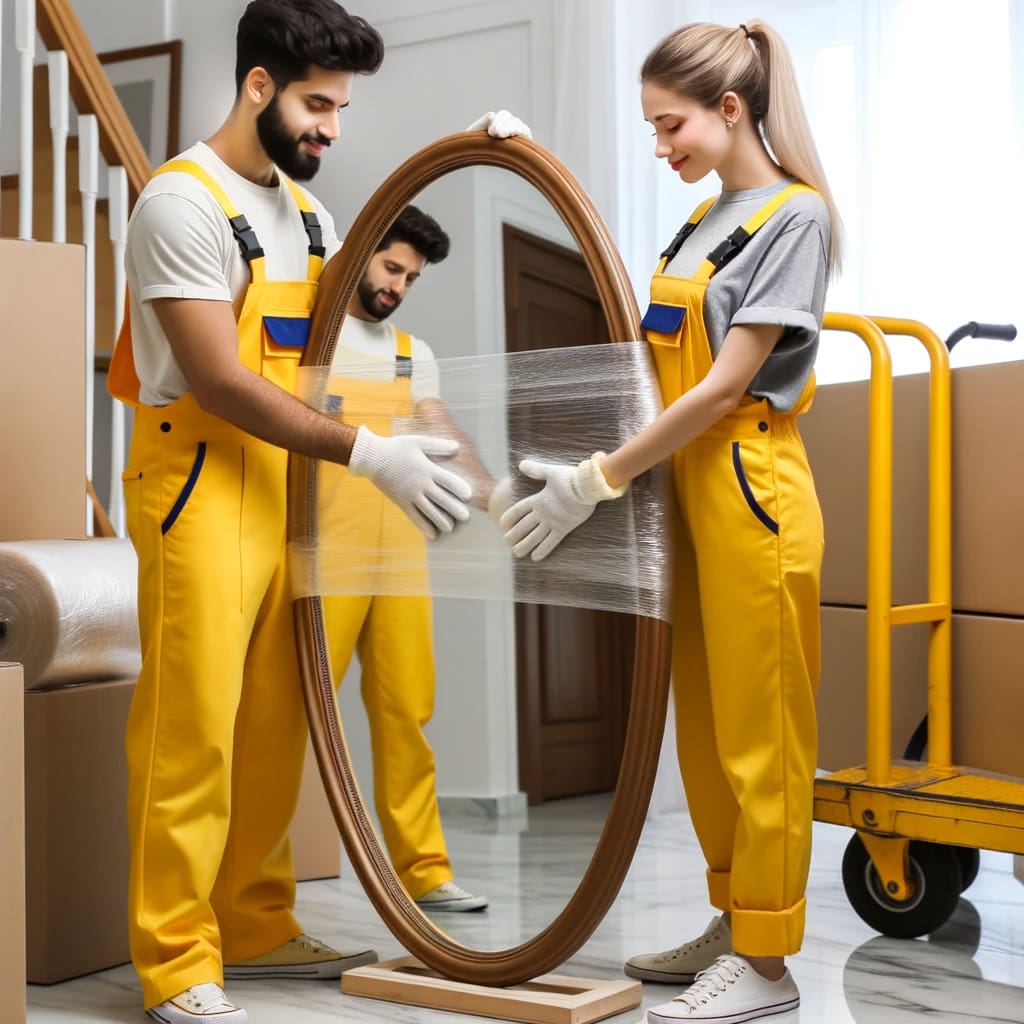
DIY mirror packing is totally doable for smaller mirrors if you have the right materials and time. But for oversized mirrors, antiques, or long-distance moves, professional packing can reduce risk—especially when your move includes insurance/valuation options and the mirror must survive multiple handling points.
Pros of DIY
- Lower cost if you already have materials.
- Full control over how the mirror is protected.
- Great for small/local moves with minimal loading/unloading.
Cons of DIY
- Higher breakage risk if the box fits poorly or the mirror shifts.
- Time-consuming, especially if you’re packing multiple fragile items.
- Harder claims process if packing quality is questionable.
Professional packing: peace of mind (especially for valuable mirrors)
If you’d rather not risk it, a professional moving team can pack mirrors using mirror boxes, pads, straps, and best-practice loading methods. If you’re moving within California (San Francisco, Los Angeles, Orange County, San Diego, Oakland, and nearby areas), Qshark Moving Company can help with careful packing and transport.
Table: DIY vs. Professional – quick comparison
| Method | Cost | Time | Risk of damage | Convenience |
|---|---|---|---|---|
| DIY | Low–Moderate | Higher | Moderate–High (depends on materials) | Lower |
| Professional | Moderate–Higher | Lower | Lower (especially for large mirrors) | High |
Common Mistakes That Crack Mirrors
- Using a box that’s too big (mirror slides and builds momentum).
- Skipping corner protection (the #1 cause of chips and cracks).
- Placing mirrors flat in the truck (flex + pressure = break).
- Taping directly onto delicate frames (finish damage when you remove tape).
- Leaving hardware exposed (D-rings/hooks can puncture wrap and scratch glass).
Frequently Asked Questions: How to Pack Mirrors for Moving
1) What’s the safest way to pack a mirror?
Protect the corners, add rigid cardboard on both sides, wrap with a moving blanket + bubble wrap, then place the mirror snugly in a mirror/picture box with voids filled. Transport it upright and strap it in the truck.
2) Should I tape an “X” on the glass?
Yes—use painters tape or masking tape. It helps hold broken pieces together if the glass cracks. Don’t use duct tape on the mirror surface.
3) Can I pack a mirror without a mirror box?
You can, but it’s riskier. Use thick blankets, bubble wrap, and a cardboard “sandwich” shield, then build a tight cardboard shell around it. If the mirror is large, heavy, or valuable, a proper mirror box (or professional packing) is strongly recommended.
4) Do mirrors travel better flat or upright?
Upright on their edge. Flat placement increases flex and pressure from stacked items, which is a common cause of cracking—especially for larger mirrors.
5) How do I pack a large mirror for a long-distance move?
Double up on corner protection, use rigid cardboard shields, and use a telescoping mirror box that fits snugly. Load it upright, between padded flat items, and secure with straps so it cannot tip or slide during braking.
6) Is professional packing worth it for mirrors?
Often, yes—especially for oversized mirrors, antiques, and any mirror you’d hate to replace. Professional movers pack mirrors with the right boxes, padding, and loading methods, and can advise on coverage/valuation options for fragile items.
7) What should I write on the box?
Write FRAGILE – GLASS, THIS SIDE UP, and DO NOT LAY FLAT. Add the destination room name to speed up unloading and reduce unnecessary handling.
 What to Pack First When Moving | Expert Tips by Qshark Moving
 How to Move a Home Gym Without Floor Damage (Treadmills, Peloton, Weights) | QShark
 Los Angeles Moving Truck Parking Guide: Permits, No-Parking Signs & Ticket-Proof Loading | QShark
 How to Pack Artwork for Moving | Qshark Moving Company
 How to Move a Pool Table | Qshark Moving Company